
Charlotte Vidal Nisbet
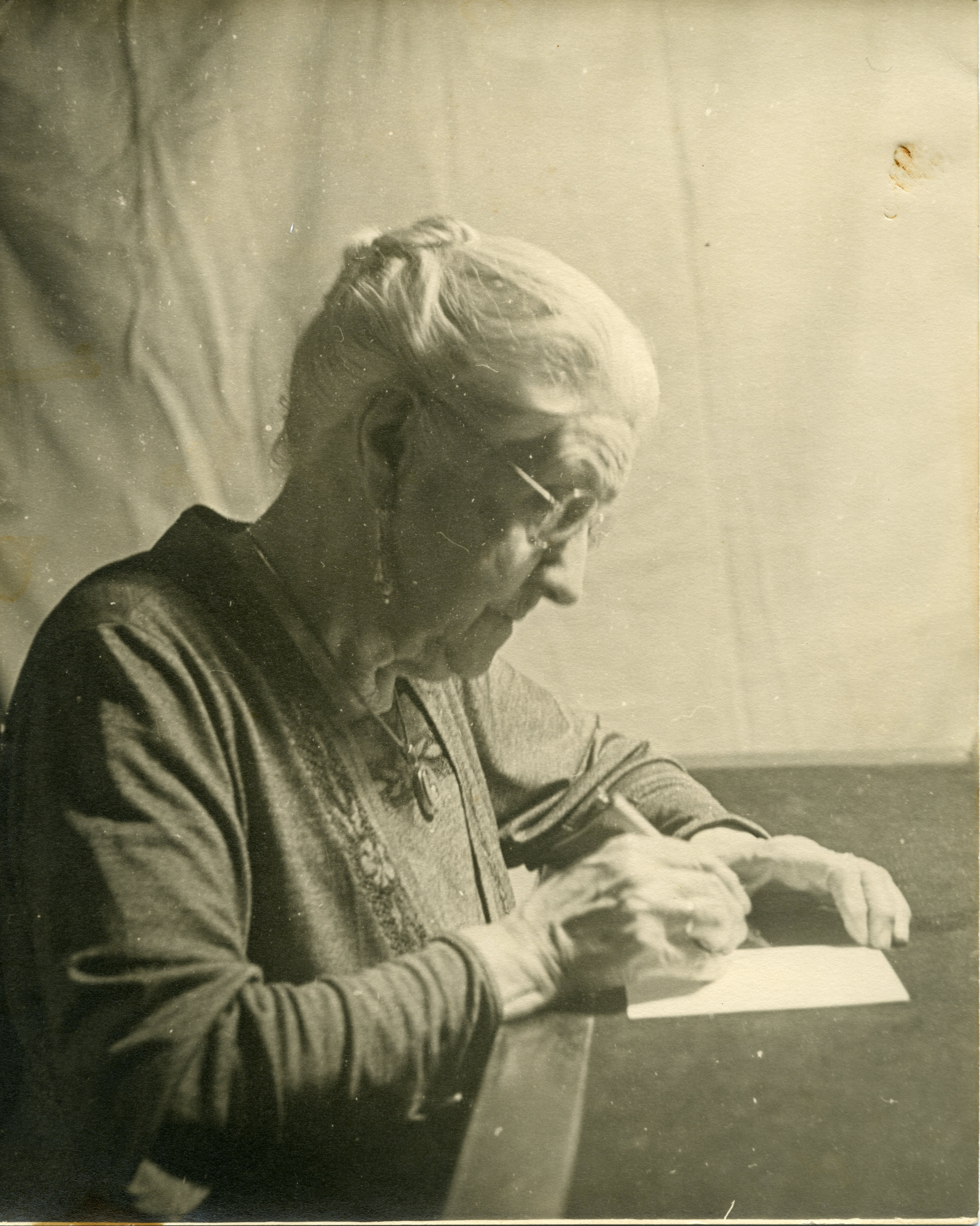
Charlotte Vidal Nisbet was a keen observer of all that she surveyed, and Sarnia’s first and most celebrated historian. Without her writings and observations, we would know far less than we do today of what life was like in our city during Victorian times.
From 1935 to 1947, Charlotte Vidal Nisbet wrote a weekly column in the Sarnia Canadian Observer. She also wrote regularly for the Western Ontario Historical Notes. More than 250 of these articles covered various aspects of Sarnia’s past.
Many of her tales were serialized: for example, for weeks she covered various aspects of life in the city that had taken place 100 years earlier, from the time of the earliest Scot and English settlers. Of many, of these, of course, she had intimate family knowledge. Another series took a look at vanished industries, vanished churches, and vanished lakes.
Her interests covered the entire breadth of the county. She recalled for her readers early pioneer days in Sarnia, Alvinston, Petrolia and Brigden. She looked back on the Wyoming bank robbery of 1922, and reported on old houses and building across the county. She travelled to Courtright on one occasion, and told her readers about the trip in detail.
Her writing was so prolific, well-written and all-encompassing that it today provides a rich resource for students, historians, writers and scholars interested in learning more about the area’s past and the way people lived, were entertained, and carried on business and day-to-day life.
An example of Charlotte's Writing
"War Pigeons Proved Their Worth" published Dec. 16, 1939 in the Sarnia Canadian Observer
How very strange that looks and sounds! They are such pretty, gentle birds, it is hard to think of them amid the noise and confusion of battle, and yet that is where many of them are at the present time. It is too early yet to get the numbers in this war, but the work of pigeons during the Great War has been told and is very wonderful. They are the most trustworthy messengers, and have carried notes which have saved the situation many times, and the list of our fighters whose live have been saved by these birds, is a long one.
Pigeons are to be found in all parts of the world, and there are at least five hundred species. Some of these are very different from those we are accustomed to see, and are worth reading about, but just now we must stick to the one kind which used to be called the "carrier pigeon" then the "homing pigeon," which name is very descriptive, for it was noticed many centuries ago that birds has a marvellous instinct for noticing and remembering places, and could be depended on to carry messages straight to their loft, or whatever their dwelling place was called. We are told that away back among the Greeks they were used to send the names of the winners in the Olympic games to various cities and towns interested. That sounds quite modern, if we just substitute baseball or football, for the older games. It shows the same love of games and sport that is so much in evidence today.
Used for Centuries
Pigeons have been used in war, far back in history, in the stories of towns and cities which were besieged. Then coming to modern times, when the Germans besieged the City of Paris in 1870-71, the French used many of them, and it is said that hawks were trained by Germans to interrupt the pigeons. It is said that the old Greeks got the art of training the pigeons from Persia. The Chinese used pigeons too, and they put bells on them to frighten away birds of prey.
In Belguim late in the nineteenth century began the sport of "racing" pigeons and it was quickly taken up in England, for in 1881 the first regular races in Great Britain too place, and ever since that time pigeons have been reared and trained for that purpose by many fanciers. After the Great War broke out, the need for the birds was felt, and a call sent out for trained birds and trainers, with the result that were was, as usual, a generous response. Before long the British Pigeon Service was established with Col. A. H. Osman, O.B.E., as director during the war. It seems that, in England alone, at least two million pigeons, old and young, are trained every year. It was found, as the war went on, that were were many times when telephone and wireless, ground telephone, and signals were out of the question, and even the trained dogs could not be sent. Then the pigeons were invaluable. A message was written on thin paper, tightly folded, and place in a tiny tube of aluminum, fastened to the bird's leg, and immediately the pigeon flew off to its own loft, which might be one of the big van-like motors with two layers of cages. These had to be moved sometimes as the army moved, but the pigeons knew their own loft and made no mistakes. As a general thing the distances were not great, and did not overtax the birds' powers, and no weather daunted the brave little messengers. There were very few failures and then, only death seemed to prevent the delivery of the message. The percentage of safe delivery of messsages was actually ninety-five.
Great Favorites
Among them all, a few were prominent for swiftness and they were great favorites with all the soldiers. One, on a very important occasion flew thirty-eight miles and delivered his message in twenty minutes.
Another was shot by a German soon after taking the air, and his leg was broken and the tiny tube with the message was driven into his body. He reached his loft the next morning, had managed to fly nine miles, wet and exhausted, and dropped dead, but he took the message safely. This bird was known as No. 2709, but after this was called the V.C. pigeon.
It was the admiralty which first recognized the value of pigeons and messengers and, once convinced, everything was done to make the service as nearly perfect as possible and every submarine and airplane was supplied with at least two birds. They certainly proved their worth. On one occasion a sea-plane was wrecked and floating helplessly miles out at sea. After a long time another sea-plane saw her, came down on the water, and took the two men on board, but something went wrong with it and the plane could not be made to rise. Their only hope was the pigeons of which they had four, so one was sent off and all day they waited and all night. Still no help came. Then another bird was released, and again they waited, cold, wet and hungry, for food was getting low, so a third pigeon went off towards land and another day passed and another night, so sadly the last bird was sent. It, too, was wet and cold and there was a strong wind blowing and driving rain, and when hours passed they gave up hope, but late in the day a grey destroyer appeared and this put fresh heart into the six men, who shouted and waved to guide the rescuers. Soon they were safe on board and taken to shore. They were told how the last pigeon had just reached shore, wet and exhausted and had died before they could read the message. So this little bird saved the lives of six men. This was only one instance out of many.
We shall doubtless hear much of the pigeons presently as this war goes on, for the French think just as much of them, as do the British, and all are so much better prepared this time.
Join Our Mailing List
Stay up to date on latest news and programs.